
Behavioral Therapist Accounting
Tax Strategy for Behavioral Health Professionals
You've built a practice that earns at a physician-level income. Your tax structure should match it. KB Tax Deviser CPAs identifies exactly what that gap is costing you and closes it.
Why High-Income Therapists Overpay in Taxes Every Year
Behavioral health professionals with complex income rarely have a tax problem. They have a structure problem. Clinical fees, insurance reimbursements, group ownership distributions, and investment income are flowing through the wrong entities, at the wrong time, under the wrong plan.
Fragmented Income Planning
Clinical revenue, group shares, and real estate sit in separate buckets with no coordinated tax strategy across them.
Wrong Entity Structure
Operating as a sole LLC well past the point where an S-corp election would reduce self-employment tax by five figures annually.
Reimbursement Timing Gaps
Insurance lag creates cash flow complexity that misaligns estimated quarterly payments and triggers underpayment penalties.
Year-End Surprises
A reactive CPA files what happened. Nobody modeled what was coming. The bill reflects that.
Outdated Retirement Planning
Contribution limits go unused because the practice structure doesn't allow for maximum tax-advantaged deferral.
No Proactive Guidance
Major decisions, adding a partner, buying real estate, expanding a group practice, get made without any modeling of their tax impact first.
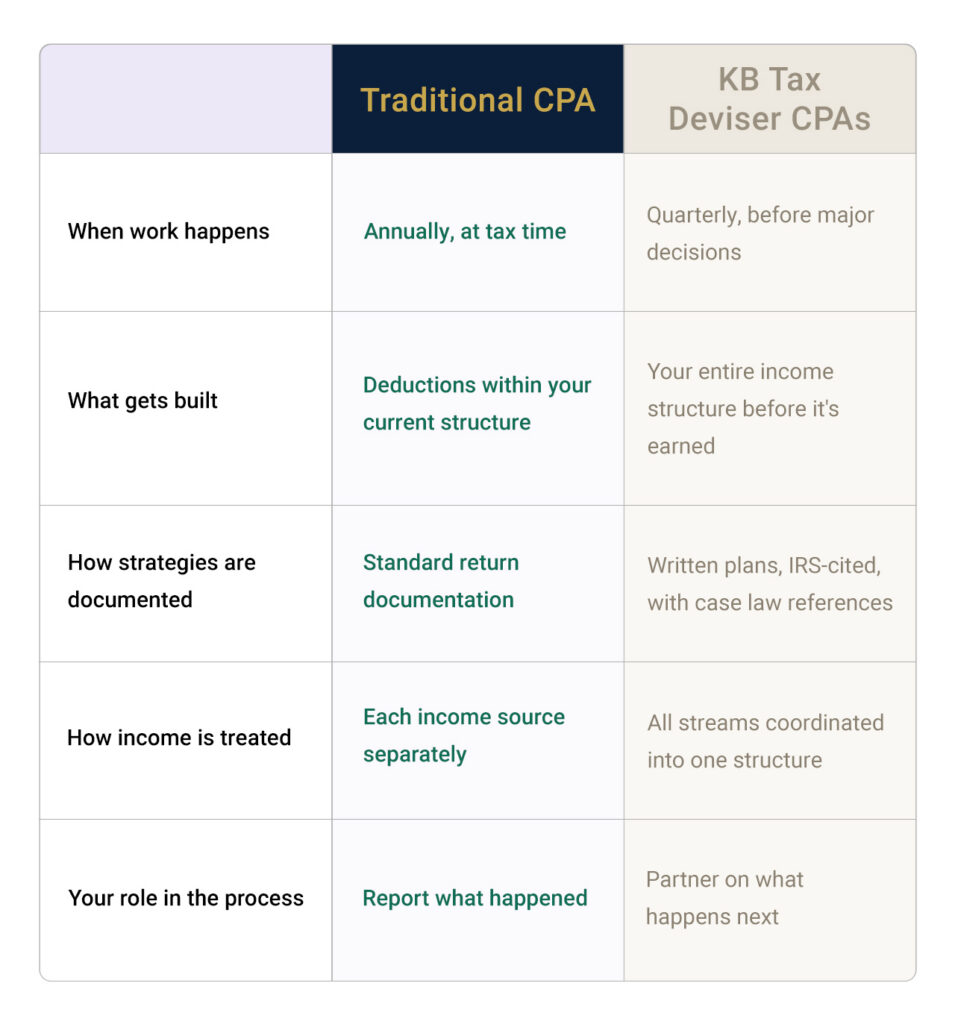
Certified Tax Strategist vs. Traditional CPA
One of only 55 Certified Tax Strategists in the United States works with you at KB Tax Deviser CPAs. That credential isn't a title; it's a different category of service entirely. The work happens before income is earned, not after it's reported.
When work happens
What gets built
How strategies are documented
How income is treated
Your role in the process
Traditional CPA
Annually, at tax time
Deductions within your current structure
Standard return documentation
Each income source separately
Report what happened
KB Tax Deviser CPAs
Quarterly, before major decisions
Your entire income structure before it's earned
Written plans, IRS-cited, with case law references
All streams coordinated into one structure
Partner on what happens next
Tax Services Designed for Behavioral Health Practice Owners
Behavioral health professionals don't have a generic income picture. A solo practice with real estate and a future group partnership requires a structure built for that specific combination, not a template pulled from a general CPA playbook.
How KB Tax Deviser CPAs Builds Your Tax Strategy
Prescribing a tax strategy without reviewing your full financial picture is guesswork. The Clarity Method™ is how KB Tax diagnoses before prescribing, every time, for every client, regardless of income level or complexity.
PILLAR 01
Understand
Three years of business and personal returns, entity structure, income streams, and 1, 5, and 10-year financial goals reviewed in full. Nothing assumed.
PILLAR 02
Identify
Every structural gap quantified in dollars, referenced to IRS code and case law. You see exactly what your current structure has been costing you, year by year.
PILLAR 03
Design
A written, IRS-cited strategy that coordinates your practice income, entities, retirement planning, and wealth goals as one structure. Not a template. Yours specifically.
PILLAR 04
Implement
Execution begins. Quarterly reviews keep the strategy current as your income, practice, and tax law evolve. You are never reacting again.
By the end of the first 30 days, you'll know exactly what you've been overpaying and precisely what changes.
Who KB Tax Deviser CPAs Work With
KB Tax works with behavioral health professionals who have outgrown standard tax compliance. If your practice generates real income, the question isn't whether you're overpaying. It's by how much. This isn't the right fit for every therapist. It is the right fit if your situation matches what follows.
- Practice Owners at $200K+ Solo and group practice owners whose income has outpaced their current tax structure and entity design.
- Multi-Stream Earners Behavioral health professionals with clinical income plus real estate, group ownership shares, or outside investments that need coordinating.
- Professionals Ready to Shift Anyone currently using a general CPA or filing solo who wants to move from reactive compliance to proactive tax engineering.
The clients who benefit most are practice owners generating $200K or more in annual clinical income, professionals managing more than one income stream, and anyone who hasn't revisited their entity structure in three or more years. If you're still asking "What do I owe?" rather than "What's my best move?" that's the gap this engagement closes.

Real Results
What Does Proactive Tax Strategy Look Like in Practice?
Most behavioral health professionals don't know their structure is costing them until someone runs the numbers. That's the first thing KB Tax does. After a full review, KB Tax identified an opportunity to save $48K annually through an S-corp election and coordinated entity restructuring.
$48K Annual Savings Identified
Through S-corp election and coordinated profit splitting across a three-partner behavioral health group.
Entity Structure Rebuilt
Three isolated LLCs consolidated into one coordinated holding structure with synchronized tax planning.
Zero Year-End Surprises
Quarterly modeling replaced reactive filing across all partners from day one of implementation.
Frequently Asked Questions
A certified tax strategist designs your income structure before taxes are filed. A regular CPA reports what already happened. There are only 55 Certified Tax Strategists in the U.S. KB Tax Deviser CPAs is one of them.
Savings vary by income and structure, but practice owners with $200K or more in annual clinical income regularly identify $20K to $60K in annual overpayments through entity restructuring and income coordination.
Generally when net income exceeds $50K annually, an S-corp election can reduce self-employment tax significantly. The exact threshold depends on your state, income mix, and how your practice is currently structured.
Yes. KB Tax reviews all income sources together, not in isolation. Clinical revenue, insurance reimbursements, real estate income, and group distributions are planned as one structure to reduce total tax liability.
Each quarter, KB Tax reviews your income activity, adjusts estimated payments, models major decisions before they're made, and updates your strategy based on changes in tax law or your practice. No year-end surprises.
Yes. Group practices with two or more partners require coordinated entity planning. KB Tax structures income allocation, profit-sharing, and buy-sell provisions with tax efficiency as the primary design criteria.
If your net income exceeds $150K, the structural savings typically outweigh the cost of strategy. Solo practitioners are often the most overpaying group because they remain in default structures well past the point where a change would pay for itself.
Insurance reimbursements create timing and cash flow complexity. KB Tax maps reimbursement lag against income recognition and estimated payment cycles to prevent overpayment and underpayment penalties throughout the year.
Week 1 covers document collection: three years of returns, entity structure, and income details. Week 2 is gap analysis. Week 3 delivers a written, IRS-cited strategy. Week 4 begins implementation with quarterly reviews scheduled from day one.
Find Out What Your Tax Structure Is Actually Costing You
KB Tax reviews the last three years of your returns, identifies every structural gap, and quantifies what it's been costing you. You will be informed directly if there are no meaningful opportunities available. That's the difference between a firm that files and a firm that builds.